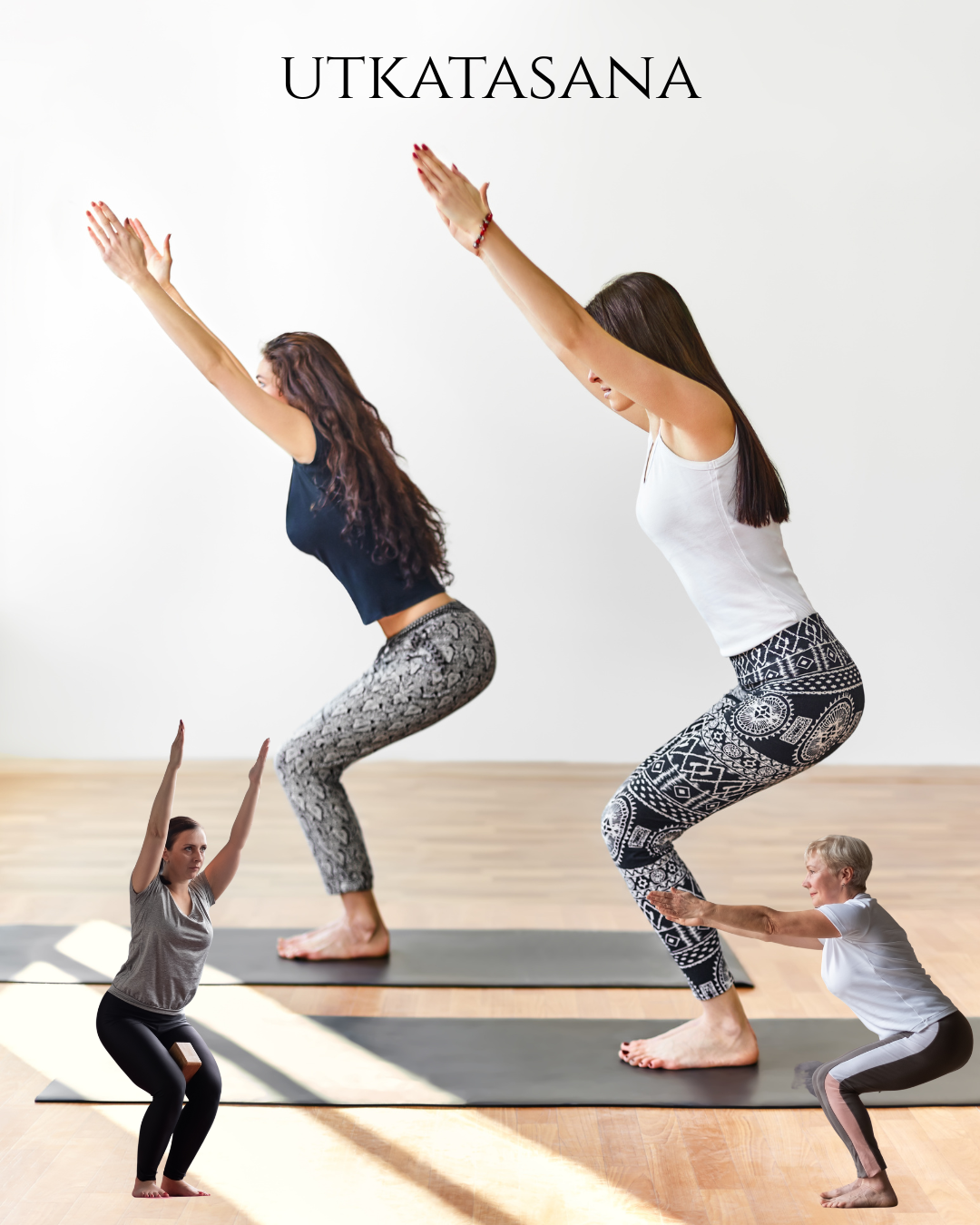
Recently, in class exploring Tapas, we were doing big, long holds of some of my favourite poses, and it became clear that I am such a fan of Utkatasana. There is not a class that goes by where we don’t visit this fire-inducing pose. Personally, using long holds for me with this pose in personal practice helps me visit it, stay and juice out the benefits. I know instinctively that this is a stabilisation asana for the knee, and I recommend it to all people who have knee problems, but today I sat down with my mat and Google and went into the intricacies of this asana, and I found names for things I’ve been feeling and put some good facts to this reason. I love it, practice it and teach it.
I’m going to preface this by saying this is the knee edition. I put in hours to research these asanas and write these articles for a very small audience, so I’m not even going to get into the shoulders, but let’s just say… It’s great for creating space, mobility and strength in the shoulders.
So the knees, my gee’s.
Let’s start with the obvious (for me at least), the inner thigh muscles. You can feel these fire up when we sit deep into this ‘fierce pose’. These are (and as if I remember these names) called the vastus medialis obliquus (VMO). These are the opposing muscle group from the lateral quads, IT band and all that dense outer thigh junk we have going on. So if the outer quads are tight or overdeveloped, this can pull our friend the patella (knee cap) off its track and then it gets all sore and wonky. Not ideal. So balance is the key here, we strengthen up these inner vastus medialis obliques (repetition may help my cause) and this keeps our knee where it needs to be. So just as a side note, it’s kinda nice to lengthen and squish out the outer thighs with foam rollers and poses like Gomukhasana when we are working with opposing muscle groups.
Then, since we are working with opposing groups, let’s look at what co-contraction does. When working quads and hamstrings at the same time we create a contraction all around the knee joint, and this creates a sleeve and compression from both sides of the joint, which creates stability and the memory of stability when we leave this pose. Good stuff.
The next obvious big muscles, yup, glutes. Gluteus medius to be precise, our side glutes. Recruiting this guy in Utkatasana prevents the knee from collapsing inward (knee valgus), and when the hips are doing the right things, so do the knees and so do the ankles, so then we have a kinetic chain alignment aka alignment. This is also very good. And! Since I mentioned the ankles let’s look at the feetsises, in Utkatasana, the feet are anchored, and this is called, I did not know this, closed kinetic chain. So when we sink the hips, we move the feet into more flexion, and building flexibility in the feet can unload pressure back up into the knee.
I’m sure you’re seeing that pattern now. Down and up the leg are all influencing the knee. I mean it’s obvious, but sometimes we don’t think about the knee within the system, but to free up mobility, create stability, we must look at the knee in relation to the whole. It is the middle joint of the leg and absolutely needs the other joint friends to be on board with health and vice versa. Bung hips peeps, listen up!
Finally, my actual favourite thing and the rabbit hole I didn’t jump down because I knew I’d never get this article finished is synovial fluid! Just saying it makes my mouth water. I’m a yoga geek, stop judging. But really, what we know, or need to know, is that synovial fluid delivers nutrients to the cartilage of the knee, and that’s important. When we come into this scrummy pose we are engaging an isometric hold. This is maintaining tension without moving through the lengthening or shortening of the muscle. Aka a hold. And what this does is it compresses and decompresses the joint, aka squeezes it. This means the synovial fluid gets circulated through the joint, and the spongy cartilage can soak it up! Hazzah! Feed the joint, my friends, feed the joint.
So that’s the tip of this asana. I didn’t even get to the shoulders, the mental endurance, the effects on the circulation, posture and full body tone. But needless to say, this is one of my top 10 asanas, maybe even in the top 5. If you have knee problems, ask a body expert about this pose or just pop it in your daily practice. I like to practice for 21 breaths, and this really takes me there. Or you can do three rounds of 7 breaths and work up from there.
Many blessings and up your asana.